
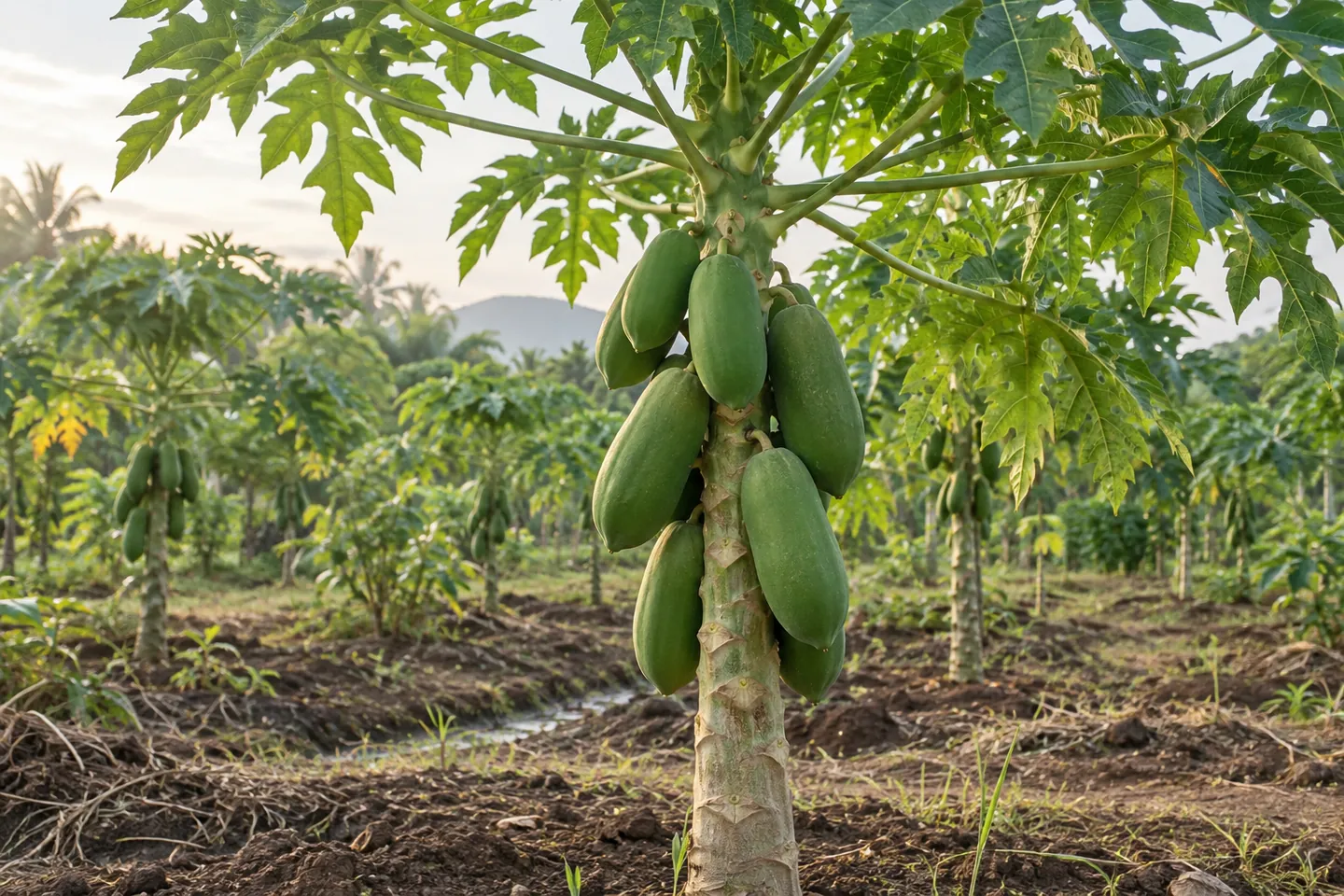
The problem
A papaya tree that grows well and flowers but carries little fruit — or drops flowers and small fruit — is a common complaint. Before reaching for fertiliser, find out which kind of tree you have and what the flowers look like.
Papaya plants come in three sexual forms: male, female and hermaphrodite. Hermaphrodite trees are preferred for dependable fruit production because they can pollinate themselves and do not need another papaya nearby.[1]
Seeds from a hermaphrodite tree give roughly one female seedling for every two hermaphrodites. The Malaysian variety 'Eksotika' segregates this way, and only hermaphrodite fruit is sold in high-end export markets.[1, 5]
Common causes
- Male trees. Male trees produce flowers but are not the fruit-bearing type; identify them early.[1]
- Female trees with no pollen nearby. A female flower needs pollen from another tree. If there is no pollen nearby, the small developing fruit aborts and falls.[1]
- Heat and water stress on hermaphrodites. Hermaphrodite flowers are unstable under some conditions. High temperature and water stress shift them toward maleness, and very high temperatures can cause 'female sterility', in which hermaphrodite trees produce male flowers and set poorly.[1, 2]
- Cool weather or very wet soil. Cool weather or high soil moisture shifts flowers toward femaleness, producing severely ridged, misshapen ('catfaced') fruit.[1]
- Drought. Papaya short of water may drop flowers, leaves and young fruit and produce small fruit with low sugar content.[4]
- Waterlogging. Papaya needs good drainage. Where drainage is restricted it is susceptible to root diseases, and plants can be killed by standing water in a matter of hours.[2]
- Boron shortage. Boron is essential for pollination and seed production. Boron-deficient trees set very little fruit, and affected fruit can be lumpy, poorly developed and low in sugar. Deficiency is more common in very wet or dry areas and in sandy or rocky soils.[3]
What to do
- Select hermaphrodite trees. If space is limited, let several seedlings grow to flowering in each planting spot, then keep the healthiest hermaphrodite and remove the rest.[1]
- Keep a pollen source for female trees. If you keep female trees, make sure there are pollen-producing trees nearby.[1]
- Water evenly, but do not overwater. Avoid drought stress, which causes flower and fruit drop, but do not overwater soils that already hold water well.[4]
- Plant on well-drained ground. Use raised beds or drains on heavy or low-lying land; papaya does not tolerate standing water.[2]
- Confirm boron shortage before treating. Compare leaf samples from healthy and affected plants, or test the soil for boron. Too much boron can severely damage or kill a plant, so only correct a confirmed shortage, following your agronomist's rate.[3]
Where NEXGROW fits
NEXGROW is a bio-organic, phosphate-solubilising fertiliser. For papaya, the product booklet describes it as promoting strong roots, better nutrient uptake and healthy new shoots, supporting flower formation, and releasing nutrients gradually for a steady supply with less leaching.
It does not change a tree's sex or supply boron to a boron-deficient soil. Use it as part of a balanced programme once the causes above have been checked. Rates below are taken directly from the booklet.
NEXGROW rates from the official product booklet: Papaya
| Usage | NEXGROW dose |
|---|---|
| Mixed during soil preparation, before planting | 250 g / m² |
| 2-month-old tree | 100 g / tree / year |
| 3-month-old tree | 150 g / tree / year |
| 4-month-old tree | 300 g / tree / year |
| 5-month-old tree | 500 g / tree / year |
| Older than 5 months | 1 kg / tree / year |
When to get a soil test
Test before planting a new papaya block, and whenever you see lumpy fruit or very poor set on hermaphrodite trees that have enough water. A soil test (and, if advised, a leaf test) confirms whether boron or another nutrient is really short before you apply anything.[3]
Not sure what is wrong with your crop?
Send photos of the leaves, fruit and roots, with the crop age and what you have applied, and an agronomist will reply on WhatsApp. For fertiliser decisions, start with a soil test.
Frequently asked questions
Why is my papaya tree flowering but not fruiting?
It may be a male tree, a female tree without pollen nearby, or a hermaphrodite tree whose flowers have been changed by heat or water stress. Boron shortage and waterlogging also reduce fruit set.
How do I get more hermaphrodite papaya trees?
Seed from hermaphrodite trees gives about two hermaphrodites for every female. Plant several seedlings per spot, wait for flowering, and keep the healthiest hermaphrodite.
Why is my papaya fruit lumpy?
Lumpy, poorly developed fruit with low sugar can be a sign of boron deficiency. Confirm it with a leaf or soil test before applying boron, because too much boron damages the plant.
Why do papaya flowers drop in hot, dry weather?
Drought stress makes papaya drop flowers and young fruit, and high temperatures push hermaphrodite flowers toward maleness, reducing fruit set.
Sources
Agronomic statements in this tip are based on the sources below. Numbers in brackets in the text refer to this list.
- [1]Why Some Papaya Plants Fail to Fruit (F&N-5) — University of Hawai'i at Mānoa, CTAHR
- [2]Papaya Production in Hawaii (F&N-3) — University of Hawai'i at Mānoa, CTAHR
- [3]Boron Deficiency of Papaya (PD-91) — University of Hawai'i at Mānoa, CTAHR
- [4]Papaya Growing in the Florida Home Landscape (HS11) — UF/IFAS Extension, University of Florida
- [5]An Improved Technique of Propagating 'Eksotika' Papaya — Acta Horticulturae 787 (ISHS)