
 Crop: Watermelon & Sandy Soils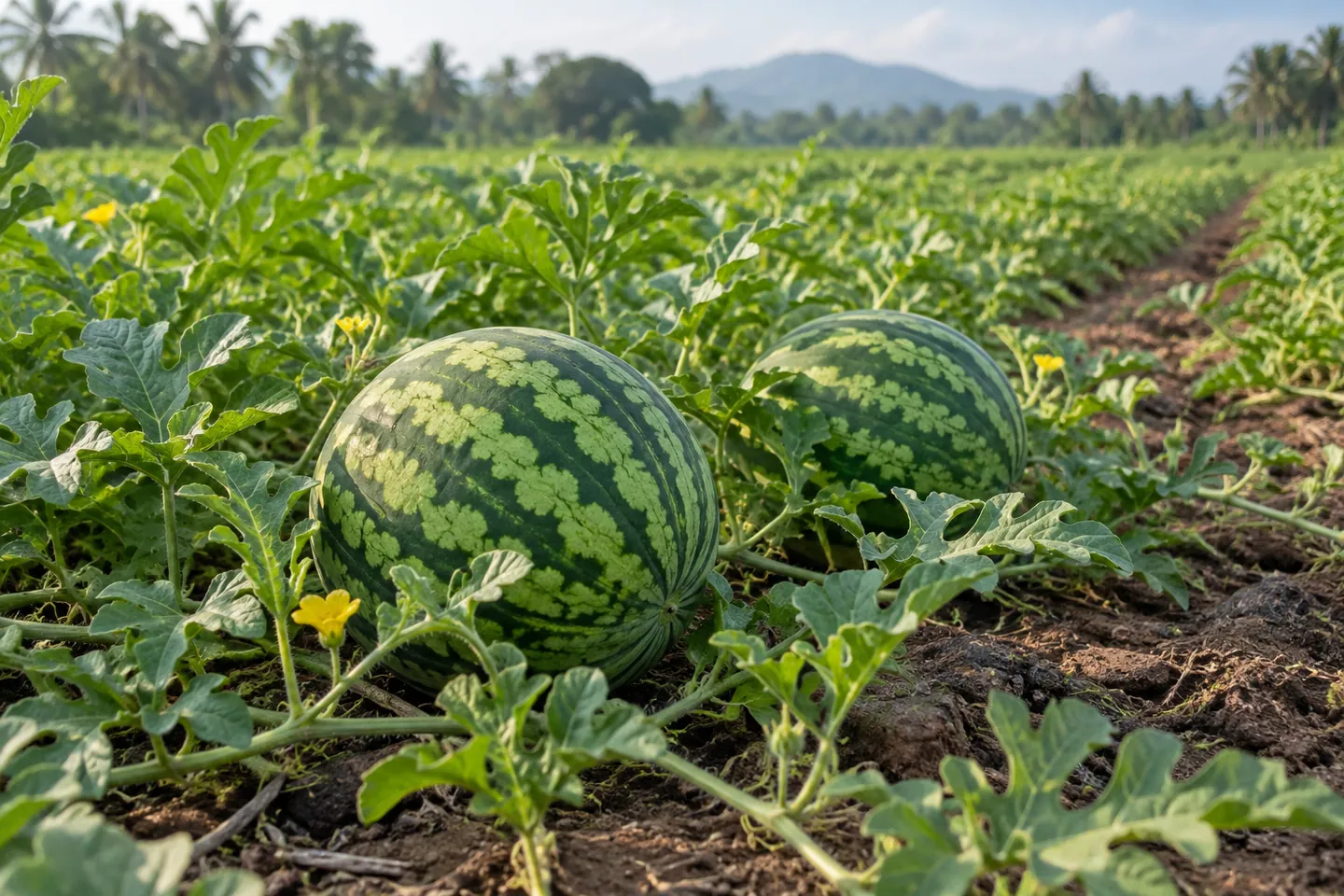
The problem
Growers cultivating watermelons, papayas, ginger and vegetable crops on coastal sandy soils (such as the BRIS soils of Terengganu, Kelantan and Pahang, or riverine sandy loams in Perak) often notice that chemical fertiliser seems to vanish within days of application.
Crops initially show a quick burst of green, but after one or two heavy rainstorms the leaves turn pale yellow. Growers apply more synthetic fertiliser, only for the cycle of rapid leaching and nutrient hunger to repeat.[1]
Studies on tropical sandy soils demonstrate that without colloidal organic matter, as much as 60% to 70% of applied soluble nitrogen and potassium washes down past the root zone into groundwater.[1, 4]
Common causes
- Extremely low Cation Exchange Capacity (CEC). Coarse quartz sand particles have virtually no negative surface electrical charge. The CEC of raw tropical sandy soil is typically below 5 meq/100g, compared to 20–40 meq/100g for fertile loam. Positively charged nutrients (potassium, calcium, magnesium, and ammonium) have no binding sites and slip right through.[1, 2]
- High macroporosity and gravitational drainage. Sandy soils have large pores between grains. Heavy tropical rainfall percolates downward rapidly, dragging dissolved mineral salts straight down beyond the active root zone.[1]
- Rapid organic matter burnout under tropical heat. High soil temperatures accelerate microbial respiration, causing raw organic matter to oxidise rapidly unless replenished with stabilised humic substances.[1, 4]
- Low moisture retention and root scorching. Because sandy soils hold little water, chemical fertilisers dissolve into a concentrated saline solution near the roots during hot afternoons, causing root dehydration and burn.[2]
What to do
Managing sandy soils requires building nutrient retention capacity, not simply adding more chemical fertiliser:
- Build active humus and soil organic matter. Humus has a massive CEC (frequently exceeding 150–300 meq/100g on a carbon basis). Incorporating aerobic bio-organic matter into the planting bed creates a colloidal network that electrostatically holds onto potassium and ammonium ions.[1, 2]
- Split fertiliser into frequent, smaller doses. Never dump large single doses of chemical fertiliser on sandy soils. Apply nutrition in smaller, more frequent increments to match what plant roots can absorb immediately.[1]
- Use mulch or ground cover. Covering planting beds with organic mulch or silver-black plastic reduces evaporative moisture loss and moderates midday root zone temperatures.[4]
- Incorporate humic and fulvic acids. Humate substances act as natural soil conditioners, coating sand particles, improving water infiltration uniformity, and reducing vertical nutrient runoff.[1]
If a chemical pesticide or fungicide is needed, consult the Department of Agriculture (DOA) or an agronomist for products registered for your crop, and follow the label.
Where NEXGROW fits
NEXGROW contains over 50% organic matter and over 20% humic and fulvic acids. When mixed into sandy soils, it supplies the negative electrical charges that sandy soils naturally lack, raising the effective CEC and locking nutrients into the root zone.
Its phosphate-solubilising microbes and aerobic organic matrix convert sandy beds from nutrient sieves into fertile, water-retentive growing media.
For crop-specific rates on sandy soils, consult the NEXGROW watermelon and vegetable programs.
NEXGROW rates from the official product booklet: Watermelon
| Usage | NEXGROW dose |
|---|---|
| Mixed during soil preparation, before planting | 500 g / m² |
When to get a soil test
Not sure what is wrong with your crop?
Send photos of the leaves, fruit and roots, with the crop age and what you have applied, and an agronomist will reply on WhatsApp. For fertiliser decisions, start with a soil test.
Frequently asked questions
What is CEC and why is it important in sandy soils?
Cation Exchange Capacity (CEC) measures the soil's ability to hold onto positively charged plant nutrients (K, Ca, Mg, NH4). Sandy soils have a very low CEC (<5 meq/100g), meaning they cannot hold onto fertilisers without organic matter.
Why do watermelons grow well on sandy soil if nutrients wash away?
Watermelons prefer well-drained, warm soils that prevent root waterlogging. However, successful watermelon growers on sandy soil rely heavily on organic matter and humates to hold moisture and food in the bed.
How does humic acid prevent fertiliser leaching in sand?
Humic acid molecules have dense negative electrical charges that bind with potassium, ammonium and calcium, preventing them from washing down with irrigation or rain.
Can I fix sandy soil with chemical fertiliser alone?
No. Without organic matter to provide cation exchange sites, increasing chemical fertiliser simply increases leaching losses, raises input costs, and risks burning roots.
Sources
Agronomic statements in this tip are based on the sources below. Numbers in brackets in the text refer to this list.
- [1]Management of tropical sandy soils for sustainable agriculture — organic matter and soil fertility — FAO
- [2]Cation Exchange Capacity and Base Saturation (C1040) — University of Georgia Cooperative Extension
- [3]Perkhidmatan Kesuburan Tanah — Jabatan Pertanian Malaysia (DOA)
- [4]Characteristics and agricultural management of BRIS soils in Peninsular Malaysia — Malaysian Agricultural Research and Development Institute (MARDI)